High-rise construction in Texas cities presents unique challenges for worker sanitation that ground-level projects simply don’t face. From the gleaming towers rising in downtown Houston to new developments in Austin’s rapidly growing skyline, construction managers must solve the puzzle of providing accessible restroom facilities for workers laboring dozens of stories above ground level. Restroom trailers serve as essential base facilities for these projects, with strategic planning required to ensure workers across all floors have reasonable access to sanitation.
The Vertical Challenge of High-Rise Restroom Access
OSHA requires restroom facilities to be reasonably accessible to workers, but high-rise construction complicates this requirement significantly. A worker on the 30th floor cannot reasonably be expected to travel to ground-level facilities for every restroom break. The time lost in vertical travel would devastate productivity, and workers might avoid necessary breaks to avoid the journey.
Industry best practices suggest providing restroom access within a reasonable vertical distance, typically interpreted as within 3-5 floors of any work area. This means high-rise projects require multiple restroom locations at different elevations as construction progresses upward.
The challenge intensifies during different construction phases. Early foundation and below-grade work concentrates workers at ground level, while vertical construction spreads the workforce across many floors. Core and shell completion often sees the highest concentration of workers, followed by interior finishing phases that may involve fewer workers per floor but more floors simultaneously.
Ground-Level Base Facilities
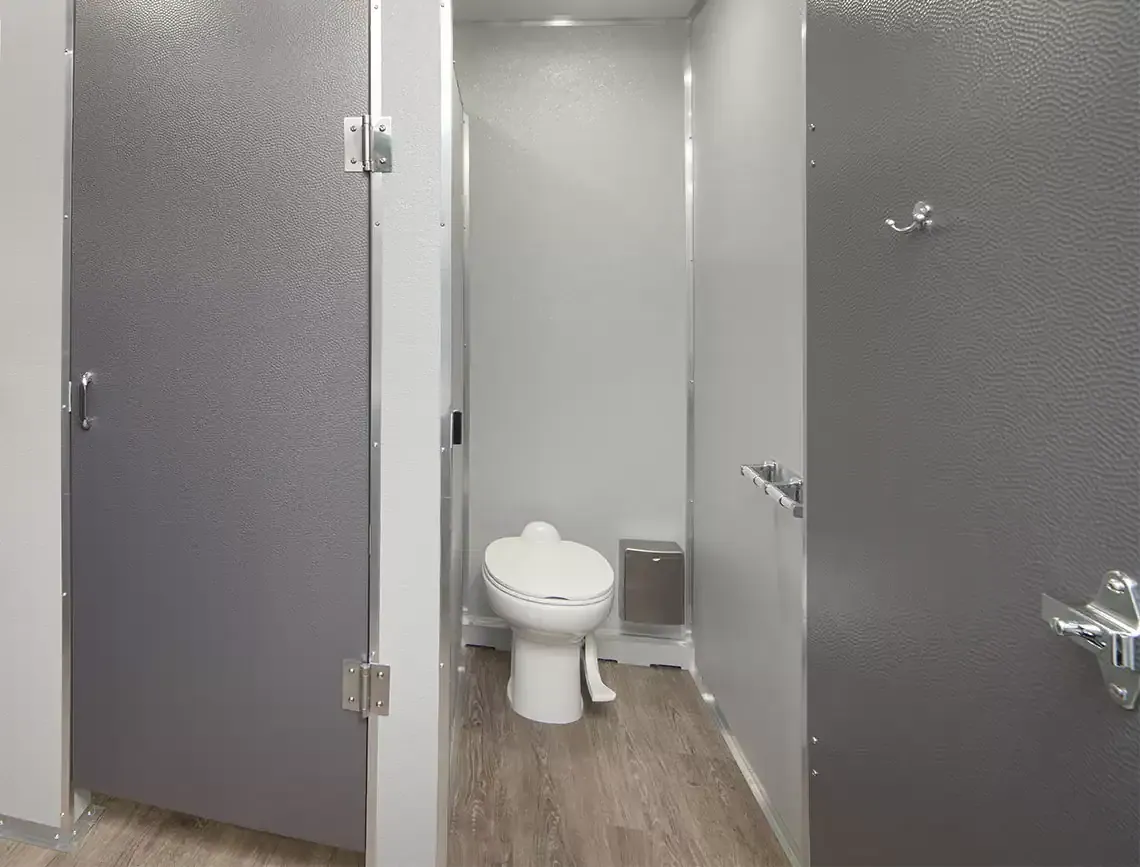
Quality restroom trailers at ground level serve as the primary sanitation hub for high-rise projects. These facilities serve workers during early construction phases, provide backup capacity throughout the project, and offer the most comfortable, fully-equipped restroom experience available on site.
Position ground-level trailers near construction elevators or hoists, minimizing the horizontal distance workers must travel after descending from upper floors. Consider locating trailers near break areas to encourage combined trips rather than multiple journeys during the workday.
Include ADA-compliant restroom trailers at ground level for workers requiring accessible facilities and for visitors to the site. Accessibility is most reliably provided at grade, where level approaches and stable ground conditions support proper accommodation.
Upper Floor Sanitation Solutions
As buildings rise, supplementary facilities must follow construction progress. Several options exist for providing upper-floor sanitation, each with advantages and limitations for Texas high-rise projects.
Self-contained portable toilets can be crane-lifted to upper floors, providing basic facilities near work areas. While lacking the comfort of ground-level restroom trailers, these units prevent excessive vertical travel for routine restroom needs. Positioning requires structural coordination to ensure floor loading capacity supports the units.
Some projects utilize building plumbing as it becomes operational, connecting temporary facilities to permanent waste lines. This approach requires coordination with plumbing contractors and careful management to prevent construction debris from entering permanent systems.
Elevator-accessible portable facilities can be moved between floors as construction progresses. This flexibility allows a smaller number of units to serve multiple floor ranges as the work focus shifts upward. Coordinate moves with construction scheduling to minimize disruption.
Texas Climate Considerations for Vertical Construction
Texas high-rise projects face unique climate challenges that affect both ground-level and elevated restroom facilities. Ground-level restroom trailers benefit from full climate control capabilities, with air conditioning essential during summer months when exterior temperatures exceed 100 degrees.
Upper-floor facilities face wind exposure that can create uncomfortable conditions in basic portable units. As buildings rise, wind speeds increase, and partially enclosed structures offer minimal protection. Consider wind direction when positioning upper-floor facilities and select units designed to withstand elevated wind conditions.
Summer heat intensifies at elevation, with direct sun exposure and lack of shade making uncooled facilities nearly unbearable. While climate-controlled options for upper floors add cost, the investment often proves worthwhile for worker comfort and productivity during Texas summers.
Service Logistics for High-Rise Projects
Ground-level restroom trailers follow standard service procedures, with regular pump-outs, cleaning, and supply replenishment. Urban Texas construction sites often require early morning or evening service to avoid disrupting daytime work and traffic patterns.
Upper-floor facilities present service complications. Self-contained units require periodic removal by crane for servicing, disrupting work and requiring coordination with other crane activities. Some projects establish service schedules that combine facility servicing with material deliveries to optimize crane time.
Waste removal from upper floors must comply with environmental and safety regulations. Gravity-based systems connected to permanent plumbing simplify ongoing service, while self-contained units require physical removal of waste. Plan service logistics during project planning to avoid mid-construction surprises.
Coordinating with Building Systems
High-rise construction progresses through phases that affect restroom facility options. During structural construction, temporary facilities operate independently of building systems. As mechanical, electrical, and plumbing systems come online, opportunities emerge for integrating temporary facilities with permanent infrastructure.
Coordinate with plumbing contractors to identify when permanent restroom facilities become operational. Transitioning workers to permanent facilities reduces rental costs and provides superior amenities. This transition typically occurs floor-by-floor as finishing work progresses.
Temporary power connections support climate control for ground-level trailers and potentially for elevated facilities. Discuss power requirements with electrical contractors to ensure adequate capacity throughout the construction timeline.
Urban Site Constraints
Texas urban construction sites often face severe space constraints that affect restroom trailer placement. Downtown Houston, Dallas, Austin, and San Antonio sites may offer minimal footprint for trailers, requiring creative solutions for worker sanitation.
Compact restroom trailer configurations maximize capacity in limited space. Multi-station trailers provide more facilities per square foot of ground coverage than multiple single-station units. Discuss site constraints with rental providers to identify appropriate configurations.
Street closures or sidewalk permits may be required for trailer placement on constrained sites. Coordinate with local authorities early in project planning to understand permit requirements and timeline. Urban Texas jurisdictions vary in their requirements and processing times.
Workforce Sizing for High-Rise Projects
High-rise construction workforces fluctuate dramatically throughout project duration. Foundation and below-grade work might involve 50-100 workers, while peak vertical construction could see 300-500 workers on site daily. Interior finishing phases often involve the highest total workforce as multiple trades work simultaneously across completed floors.
Calculate restroom requirements based on peak workforce and vertical distribution. OSHA minimums apply to total workforce, but practical distribution requires additional planning. A tower with 400 workers needs facilities distributed across working floors, not concentrated at ground level.
Shift schedules affect facility requirements. Projects with multiple shifts need facilities available around the clock, with service scheduled during shift transitions or overnight hours.
Safety Considerations
Restroom facility placement must consider high-rise construction safety requirements. Ground-level trailers should be positioned outside crane swing radii and away from potential falling object zones. Upper-floor facilities require secure positioning to prevent displacement during high winds or construction activities.
Clear, well-lit paths to restroom facilities reduce trip hazards and encourage proper facility use. Construction sites often involve cluttered, changing conditions, and maintaining clear access to sanitation prevents safety incidents.
Emergency procedures should address restroom facility access. Workers should know the nearest facility locations and alternative options if primary facilities are temporarily inaccessible due to construction activities or emergencies.
Managing Multiple Subcontractors
High-rise projects involve numerous subcontractors working on different aspects of construction simultaneously. General contractors typically provide restroom facilities for all workers, with costs allocated through subcontract provisions. Clear communication about facility locations, rules, and maintenance expectations prevents conflicts.
Subcontractor work areas shift as construction progresses. When steel workers complete upper floors and finish trades move in, facility needs shift correspondingly. Maintain communication with major subcontractors about their workforce sizes and work locations to anticipate facility needs.
Peak subcontractor overlap creates highest demand periods. When multiple trades work simultaneously, facility requirements exceed any single trade’s needs. Plan for these overlap periods when establishing facility capacity.
Planning Your High-Rise Project Restroom Strategy
Successful high-rise construction restroom planning begins with understanding your project’s complete vertical development timeline. Map anticipated workforce distribution by elevation, identify phase transitions that affect facility needs, and plan ground-level trailer capacity to serve as your primary facility hub throughout construction.
Working with experienced Texas restroom trailer providers ensures appropriate recommendations for your urban high-rise project. Local providers understand city-specific regulations, permitting requirements, and logistical challenges that affect trailer placement and service in Texas metropolitan areas.
Quality ground-level facilities establish the foundation for your project’s sanitation strategy, supplemented by appropriate upper-floor solutions as construction rises. This layered approach ensures worker access at all elevations while maintaining the comfort and hygiene standards that quality restroom trailers provide. Request a quote today to discuss restroom trailer solutions for your Texas high-rise construction project.