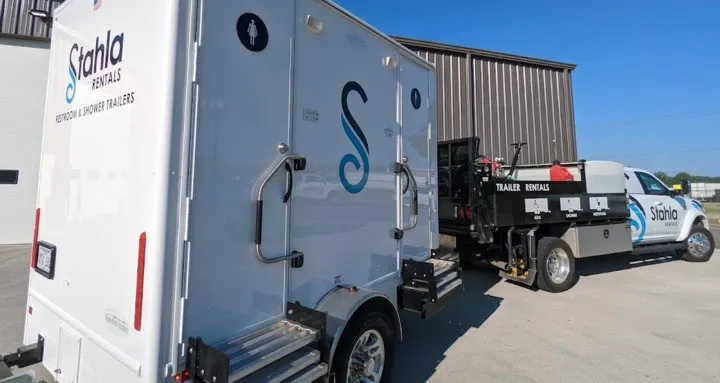
One of the most common questions event planners ask is: “How many restroom trailers do I actually need?” Get it wrong and you either waste money on excess capacity or leave guests waiting in frustrating lines. This guide provides practical formulas and considerations for calculating the right restroom trailer capacity for any Texas event.
The Basic Formula: Starting Point for Capacity Planning
The event industry uses a standard baseline calculation: one restroom stall per 50 guests for events lasting up to four hours. For a 200-person event, that means at least four stalls. A standard restroom trailer typically offers 2-6 stalls depending on the configuration, so you’d need one to two trailers for this size event.
However, this baseline only works for straightforward situations. Real-world events have variables that push capacity needs up or down. Smart planners account for these factors rather than relying solely on simple math.
Event Duration Matters Significantly
The four-hour baseline requires adjustment for longer events. As event duration increases, so does restroom usage. Here’s how to modify your calculation:
- Events under 4 hours: Use the 1:50 ratio (one stall per 50 guests)
- Events 4-6 hours: Increase to 1:40 ratio
- Events 6-8 hours: Use 1:35 ratio
- Full-day events (8+ hours): Use 1:25 ratio or better
- Multi-day events: Plan for 1:20 ratio with scheduled servicing
These adjustments account for the cumulative effect of guest usage. A guest at a two-hour cocktail reception might use facilities once. That same guest at an all-day wedding celebration will likely use them three or four times.
Gender Ratio Considerations
Events with predictable gender ratios allow for strategic capacity planning. Women’s restroom usage typically takes longer than men’s, which creates different demand patterns. Here’s how to account for this:
For events with an even gender split, standard ratios work well. For events with higher female attendance—bridal showers, certain fundraisers, or professional conferences in female-dominated industries—increase your women’s facilities by 30-50% above baseline.
Some restroom trailers offer configurable interiors that can adjust the ratio of women’s to men’s stations. Discuss this flexibility with your rental provider when your event demographics warrant adjustment.
Food and Beverage Impact
What you serve affects how often guests need facilities. Open bar events see 20-30% higher restroom usage than events serving only beer and wine. Full meal service with multiple courses increases usage compared to appetizer-only receptions.
Coffee service at morning events or conferences drives higher-than-normal usage. Events featuring signature cocktails, especially those with diuretic ingredients, should plan additional capacity.
Consider Texas’s climate in this calculation. Hot summer events where guests hydrate heavily—as they should—will see elevated restroom needs. Plan for 25-40% more capacity at outdoor summer events compared to climate-controlled indoor gatherings.
Peak Usage Planning
Events don’t see even restroom usage throughout their duration. Usage spikes at predictable moments:
- Arrival period: Guests often use facilities immediately after arriving
- Intermissions or breaks: Conference sessions, ceremony-to-reception transitions
- Before and after meal service: Notable spikes at both ends
- Before departure: Many guests make one final visit before leaving
Your capacity should handle these peaks, not just average usage. An event that sees 200 guests spread evenly needs different planning than one where 200 guests all arrive within a 30-minute window.
Texas Venue Considerations
Texas venue characteristics affect capacity calculations. Ranch weddings, winery events, and festival grounds often have guests spread across large areas. When restroom locations require significant walking, guests may delay visits and create surge usage when they do go.
Consider positioning multiple smaller trailer units at strategic locations rather than one large trailer at a single point. This reduces walking distance for guests and distributes usage more evenly.
Temperature plays a role too. During Texas summer events, guests spending time in air-conditioned restroom trailers may take longer visits simply for the comfortable temperature. This effectively reduces throughput and requires additional capacity to compensate.
Calculating for Different Event Types
Different event categories have distinct usage patterns. Here are capacity guidelines for common Texas events:
Weddings
Weddings run long and involve significant food and beverage consumption. For a 150-guest wedding lasting 5-6 hours:
- Baseline calculation: 150 ÷ 40 = 3.75 stalls (round to 4)
- Open bar adjustment: Add 25% = 5 stalls
- Summer outdoor event: Add 25% = 6-7 stalls
A 6-station restroom trailer or two 3-station trailers would serve this event well.
Corporate Events and Conferences
Conferences have scheduled breaks that create predictable usage spikes. For a 300-person conference:
- Baseline for 6-hour event: 300 ÷ 35 = 8.5 stalls (round to 9)
- Heavy coffee service: Add 20% = 11 stalls
- Consider break timing: Peak capacity matters most
Position units near session areas so guests can access facilities quickly during limited break windows.
Festivals and Multi-Day Events
Large outdoor festivals require substantial capacity with regular servicing. For a 1,000-person festival:
- All-day event calculation: 1,000 ÷ 25 = 40 stalls
- Multiple locations recommended
- Include ADA-accessible units at each location
- Schedule mid-event servicing for events over 8 hours
Don’t Forget ADA Requirements
Your capacity planning must include accessible facilities. At minimum, 5% of your restroom stations should be ADA-compliant, with at least one accessible unit regardless of event size. For events at public venues or those open to the general public, this isn’t optional—it’s legally required.
ADA-compliant units have fewer stalls per trailer due to the larger interior space required. Account for this in your total capacity calculation. A 4-stall luxury trailer and a 2-stall ADA trailer together provide 6 total stations.
The Cost of Getting It Wrong
Underestimating restroom needs creates guest frustration and lasting negative impressions. Long lines at poorly planned events become what guests remember and discuss. For weddings and milestone celebrations, inadequate facilities can overshadow the event itself.
Overestimating wastes budget that could enhance other aspects of your event. Unused capacity is money spent without benefit. The goal is right-sizing—adequate capacity without unnecessary excess.
When in doubt, err slightly toward more capacity. The marginal cost of one additional station is typically far less than the impact of visible lines and frustrated guests.
Quick Reference Capacity Chart
Use this chart as a starting point, then adjust for your specific event factors:
- 50 guests, 4 hours: 2-3 stalls (1 small trailer)
- 100 guests, 4 hours: 3-4 stalls (1 medium trailer)
- 150 guests, 6 hours: 5-6 stalls (1-2 trailers)
- 200 guests, 6 hours: 6-8 stalls (2 trailers)
- 300 guests, 8 hours: 10-12 stalls (2-3 trailers)
- 500 guests, 8 hours: 18-22 stalls (4-5 trailers)
Add 25-40% for outdoor summer events, open bar service, or older guest demographics with potentially higher usage needs.
Working with Your Rental Provider
Experienced restroom trailer rental companies have planned thousands of events and can offer valuable guidance. When requesting a quote, provide:
- Expected guest count
- Event type and duration
- Venue details (indoor, outdoor, location)
- Food and beverage plans
- Event date and time of year
- Any special considerations or concerns
A good provider will help you balance adequate capacity with budget efficiency. They’ll recommend trailer configurations that fit your needs without overselling unnecessary equipment.
Get the Right Capacity for Your Event
Proper restroom capacity planning ensures your guests have a comfortable experience without visible lines or inconvenient waits. Take the guesswork out of your planning by working with professionals who understand Texas events.
Ready to determine the right restroom trailer capacity for your upcoming event? Request a quote and our team will help you calculate exactly what you need based on your specific event details.